
Why no-shows quietly ruin tournaments (and what they actually cost)
A no-show occurs when a registered player fails to arrive at their scheduled match without prior notice, forcing organizers to reshape brackets, forfeit matches, or refund other participants.
The direct financial cost
Venue costs are fixed whether the last court is full or not. Prize money, if you promised it, is already in the plan. Catering, ball orders, and staff hours are sunk before the first serve. You cannot un-buy 40 tubes of balls because six pairs ghosted you.
Take an illustrative padel example, not a case study: 32 teams, a 20% no-show rate, about 6 empty teams. If each empty team costs you around $30 in court time and materials you cannot recoup, you are absorbing $180 or more, plus the messy job of rebuilding the draw.
The hidden operational cost
The money is only half of it. Reshaping a bracket on the morning of the event is easily an hour or two of manual work, usually while players are already warming up. The pairs who arrived play a walkover or sit around. They remember that. Organizers who "always have empty slots" lose returning participants, and the volunteer who used to help you starts finding other plans for Sunday.
No-shows vs cancellations: different problems, different fixes
Treat these as three separate events:
- True no-show: zero communication. Worst case. You find out when they are not on court.
- Late cancellation (under 48 hours): they told you, but you have no time to backfill.
- Timely cancellation (over 48 hours, with a waitlist): the ideal. You can refill the spot.
Payment method is what moves people from the first bucket into the third. A clear policy is what makes the second bucket less painful.
| Registration method | Typical no-show range | Organizer time |
|---|---|---|
| Manual (WhatsApp / paper) | About 15-25% | High: chasing every name |
| External payment + manual approval | About 10-20% | Medium: reconciling proofs |
| In-app payment | About 3-7% | Low once setup is done |
| Deposit / credit card hold | About 3-7% | Low, and fees only on problems |
Ranges are organizer estimates from racket sports events we see and hear about, not a formal industry survey. Your club may sit above or below them.
The 4 ways to handle tournament registrations
Tournament registration methods fall into four categories, each defining how players sign up, how they pay, and how organizers protect themselves from no-shows.
1. Manual (offline)
WhatsApp, email, or paper. You collect names, money, and cancellations by hand. Zero setup, zero protection.
2. External payment
Players sign up in a form or app, then pay by bank transfer, cash, Revolut, Zelle, or similar. You approve the spot yourself.
3. In-app payment
Self-serve signup plus a card payment through Stripe, Iyzico, or a similar processor. The spot is financially committed.
4. Deposit / card hold
Self-serve signup with a credit card pre-authorization. You only capture the funds if they no-show or cancel late.
Let's look at each in detail, including when each one actually makes sense.
Method 1: Manual registration (WhatsApp, email, paper)
Manual registration means the organizer personally handles every step: receiving requests, tracking payments, updating attendance, and managing cancellations by direct message or spreadsheet.
How it works
A player messages you on WhatsApp, Instagram, email, or the phone. You reply with a slot confirmation. Payment happens in person at the venue, or later via bank transfer or cash. Attendance lives in a notes app. Cancellations are a string of one-off decisions.
Pros
- Zero setup cost and zero processor commission.
- Full flexibility on prices, discounts, and "just this once" exceptions.
- Personal relationship: players feel seen, which matters in a small club.
- Fine for very small groups (under about 10 players) and for free events.
Cons
For a 32-team padel tournament this becomes a part-time job. Three to five hours a week of messages is common. There is no structural protection against no-shows. Wrong entries and forgotten confirmations pile up. You become the bottleneck. Sunday-morning "are we still on?" texts are how organizers burn out.
When manual registration works
Recurring groups of under 10 people who all know each other. One-off casual events (birthday mixers, a corporate offsite). Free tournaments where no money changes hands.
When to move on
Tournaments with 20 or more participants. Recurring monthly events. Any event where cancellation messages start numbering in the dozens. If registration is eating the week before the event, the method has already failed.
Method 2: Self-serve registration with external payment
External payment registration lets players sign up through a form or app, then pay the organizer directly through bank transfer, cash, or third-party services like Revolut or Zelle, before manual approval confirms their spot.
How it works
The player registers in your system. They send the fee by bank transfer, cash, or a peer-to-peer app (Revolut, Zelle, Venmo, PayPal.me). They screenshot a proof of payment, or they tell you they paid. You check, then you approve the registration.
Pros
- Zero transaction commission. You keep 100% of the fee.
- Familiar payment methods, especially in communities that still live on transfers.
- A documented spot reservation, which is already better than a chat thread.
Cons
You still approve every person. Late payments mean late confirmations, which means last-minute drama. There is still no structural protection against no-shows: paying on Thursday does not stop someone disappearing on Saturday if you have no refund rules. Reconciliation ("did they pay?") is its own weekend sport.
When this method makes sense
Countries or age groups where card payment adoption is low. Communities that already trust bank transfers. Events where a 2-3% processor fee would eat a thin ticket price. Clubs that already run a till and would rather take cash at the desk.
When it falls short
High-volume tournaments, because proof-of-payment approval does not scale. Players who want instant confirmation. International participants, for whom a bank transfer is slow and expensive. Recurring events where you would rather spend Sunday on the draw, not on screenshots.
Method 3: In-app payment (Stripe, Iyzico, etc.)
In-app payment collects the registration fee on the player's card through a processor such as Stripe or Iyzico, giving organizers a confirmed spot and structural no-show protection.
How it works
The player picks the tournament and enters card details. Two capture timings exist in the wild:
- Charge immediately: the card is billed at signup. Simple, but you pay processor fees even if they later cancel inside a free window.
- Authorize now, capture later: the card is held at signup and charged after the tournament starts (or after the free-cancellation window closes). Cancellations inside the window can be released with no processor fee.
Registration confirms automatically once the card is authorized. Refunds go through the processor, which gives you a paper trail. Money lands in your Stripe or Iyzico account on that provider's payout schedule, usually a few business days.
The delayed-capture pattern is the one we recommend for tournaments, and it is how SliceWin collects in-app registration fees: pre-authorize at signup, charge after the event starts, release if they cancel in time.
The economics of processing fees
Processor fees are the usual objection. They are real, and they are almost always smaller than an unpaid empty court. Published standard rates as of 2026:
| Processor | Base fee | Extra fees | Typical payout |
|---|---|---|---|
| Stripe (EEA) | 1.5% + €0.25 on standard EEA cards | UK cards 2.5% + €0.25; international 3.15% + €0.25; +2% if currency conversion | A few business days |
| Stripe (US) | 2.9% + $0.30 on domestic cards | +1.5% international; +1% if currency conversion | About 2 business days |
| Iyzico (Turkey) | Varies by agreement | Published starting rate is 4.29% + ₺0.25; volume deals can be lower | Often weekly; confirm in your contract |
Confirm live numbers on Stripe's pricing page and your Iyzico contract. Regional processors (PayMongo and others) publish their own rates. These figures change.
The math on a $30 registration: a US domestic card costs about $1.17 (2.9% + $0.30). A standard EEA card on a €30 fee costs about €0.70 (1.5% + €0.25). On a 64-player event that is roughly $75 in US fees, or about €45 in EEA fees. Compare that with a 20% no-show at $30 a player: about $384 of lost registration revenue, before you count the empty courts.
Paying ~3% to stop a 15-25% hole is, for most clubs, an easy trade. If your time is worth anything, it is an even easier one.
Pros
- Near-elimination of casual no-shows. Paid players show up.
- Instant (or same-session) confirmation for the player.
- Automatic reconciliation. You are not hunting screenshots.
- Refunds via the processor leave a clean trail if someone disputes later.
Cons
Processing fees eat a slice of margin. You need a merchant account (Stripe, Iyzico) and the KYC that comes with it. Chargebacks exist, so your cancellation copy has to be clear. You still need a refund workflow, even if the software handles the button.
Cancellation policy considerations
Decide the windows before you open registration, then stick to them:
- Full refund well in advance (often 7 to 14 days out).
- Partial refund in the middle window (for example 50% from 7 days down to 48 hours).
- No refund inside 48 to 72 hours, unless you choose to make an exception.
Automated refund versus organizer-triggered: pick one and say it at signup. Delayed capture helps here, because a release before capture costs nobody a Stripe fee.
When in-app payment fits
Tournaments with 20 or more participants. Recurring events, where the setup cost is amortized. Regions where card usage is high (most of the US, UK, Ireland, Australia, and much of the EU). Any organizer whose time is worth more than a few percent of the ticket.
This is the default for established clubs and semi-professional organizers. If you want to spend the weekend on the tournament rather than chasing payments, start here.
Method 4: Deposit / credit card hold (the smart hybrid)
A deposit or credit card hold pre-authorizes a player's card for the registration amount without actually charging it, only capturing the funds if the player fails to show up or cancels late.
How pre-authorization works
When the player registers, the payment processor places a hold on the card. No money moves yet. The amount is reserved, the same way a hotel holds a card at check-in. Standard online card authorizations typically last about 7 days. Some processors and merchant categories support extended holds of up to 30 days. If you run events more than a week out, you need a provider (and a flow) that can re-authorize or extend the hold. Do not assume a 7-day hold covers a tournament you opened a month early.
Player shows up
Hold is released. Zero processor commission. They pay at the venue (cash, transfer, Revolut) or you collect the fee some other way.
Player no-shows or cancels late
You capture the hold. The card is charged. The loss on that empty slot is covered, and the processor fee applies only to that capture.
That is the whole trick: protection without billing the 80% of players who behave.
Why this method is elegant
You keep the best of both worlds. Zero commission on clean registrations, like external payment. Structural no-show protection, like in-app payment. Players do not feel "charged up front," which is psychologically softer. Only the people who create the problem pay for the system. If you already collect at the desk, this is usually the method that matches how the club actually works.
An illustrative example
32-team monthly padel night
Suppose a club runs 32 teams at $60 per team. A historical 20% no-show is about 6 teams and $360 of lost registration, before empty-court cost. With deposit mode they still collect $60 at the venue from the teams that arrive, with no processor fee on those 25 or 26 teams. The 6 or 7 no-shows get charged $60 on the held card. Result in this illustration: the hole is covered, and you did not pay Stripe on the well-behaved majority.
This is a worked example, not a claim about a specific club.
Pros
- Zero commission on players who show up (the majority).
- No manual chasing of no-shows.
- You keep your preferred collection method at the venue.
- Platform and processor cost lands on the people who created the loss.
Cons
You still need a payment processor. The legal side is more precise than a simple charge: you must say what you are holding, for how long, and when you will capture. Not every processor supports long holds (Stripe's standard online hold is about 7 days; 30-day windows need a specific extended-authorization flow). The player needs a valid card, which excludes some markets and some older or cash-only members.
Legal considerations (not legal advice)
Card holds are a card operation. Treat them like one.
- EU (PSD2 / SCA): pre-authorization must go through Strong Customer Authentication, usually 3D Secure, at the time of the hold. Disclose amount, duration, and capture conditions.
- UK: post-Brexit rules still expect SCA-style authentication plus UK consumer-protection standards. Same practical advice: explicit consent at registration.
- US: consent must be explicit. Card-network rules and state consumer law both care that the player knew a hold could become a charge.
Always show, before they submit: the amount held, how long it lasts, and the exact conditions of capture (no-show, late cancel, or both). If you cannot explain it in one screen, you are not ready to turn the feature on. This article is practical guidance, not a substitute for advice from your provider or a lawyer.
When deposit mode wins
Recurring tournaments in markets where people have cards. Players already trust the organizer. You want zero commission on the 80% who behave. Payment at the venue is the club's normal habit. If that is your world, deposit is usually the smartest of the four methods.
Cancellation policies: rules that actually protect you
A tournament cancellation policy defines the refund terms, timing, and conditions under which players can withdraw from a tournament without penalty.
The universal 3-tier structure
Most events can live on this template. Publish it at registration, not in a PDF nobody opens:
| Window | Typical rule | Why it exists |
|---|---|---|
| More than 7 days before | 100% refund or full release of the hold | Players can still plan. You can still refill. |
| 48 hours to 7 days | 50% refund, or capture half the hold | You have already committed courts, balls, or staff. |
| Inside 48 hours | No refund | You cannot backfill. The loss is structural. |
Waitlist integration
A cancellation in the refund window should trigger the waitlist. If someone takes the spot, the financial hit disappears and a waitlisted player gets a game. Policy plus waitlist is what makes "100% refund 7 days out" affordable.
Communicating the policy
Show it on the registration screen. Repeat it in the confirmation message. Send a reminder 48 hours before the event with the cutoff in plain language. Buried terms do not survive a chargeback.
Edge cases to plan for
- Team registrations: what happens if one partner drops? Can they replace, or does the whole pair cancel?
- Medical / emergency exceptions: decide who can grant them, and write that you might.
- Weather or club cancellation: if you cancel, a full refund is the standard and the right call.
- Disputes: name a simple appeal path (message the organizer, decision within X days).
Whichever registration method you choose, a clear cancellation policy pairs with it to protect both organizer and player.
Waitlists: turning cancellations into opportunities
A tournament waitlist is a queue of interested players who couldn't secure an initial spot, ready to be offered a place when someone cancels.
Why waitlists matter more than most think
Clubs over-index on avoiding no-shows and underuse waitlists. Plenty of "full" events still start with empty slots because nobody was lined up to take a cancellation. A waitlist turns a Wednesday dropout into a Thursday thank-you from someone who wanted in.
Promotion rules that work
When a spot opens, notify waitlisted players immediately. Two workable patterns:
Sequential offer
Next person in line gets a 12 to 24 hour window. If they do not confirm, the offer falls through to the next name.
Open race
Eligible waitlisted players are notified together. The first to complete join (and payment or deposit, if required) takes the spot.
Sequential is fairer on paper. An open race is faster, which matters inside 48 hours. Staff should always be able to promote someone by hand when they know the club.
Player-side experience
Tell people they are on the waitlist. Notify them when a spot opens. Handle payment or deposit the same way as a direct registration, so you do not create a second, unprotected class of player.
How SliceWin handles registrations, payments, and no-shows
For context, our team built SliceWin, a mobile and web platform for racket sports tournaments and court bookings, to solve exactly these registration problems. Here is how each method we discussed is implemented.
Self-serve player registration
Players sign up in the app or from a public tournament link. Organizers can also add players by hand, so nobody is forced to download anything. When the event is full, players can join a waitlist. If a participant leaves or you raise the cap, waitlisted players get a notification and can take the spot through the normal join flow. Staff can also add someone from the waitlist directly in the lobby.
Payment options built in
You choose one collection method per tournament:
- External payment (free plan): players see the fee. You collect cash, transfer, or whatever you already use. No SliceWin commission.
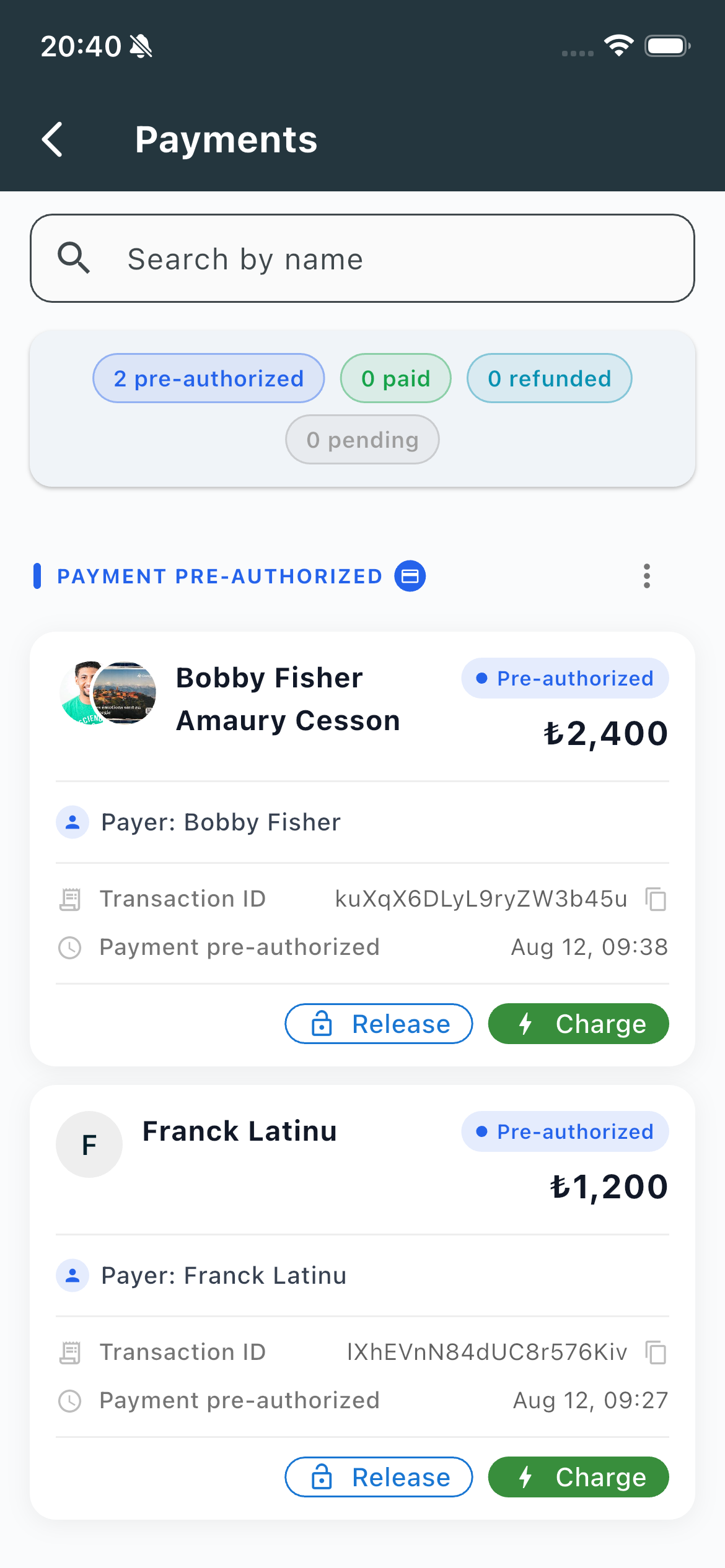
- In-app payment (Pro): the full fee is pre-authorized on the card, then charged after the tournament starts. A cancellation inside your free window can be released with no processor fee.
- In-app deposit (Pro): a hold secures the place. It is released after the tournament starts unless they no-show or cancel late. Processor fees apply only when you capture.
- Free tournaments: full formats and rankings, no payment layer at all.
In-app payment and deposit run through your Stripe or Iyzico account. SliceWin does not take a cut of registration revenue. Pro is a fixed monthly subscription (see current pricing), not a per-player commission. Setup lives under Club settings → Payments. Full walkthrough: Collect tournament registration fees.
Configurable cancellation window
Each paid tournament has a free-cancellation period you set: until start, a number of hours or days before start, or never. Inside that window, a cancellation can release the authorization. After it, a late cancel or no-show can be charged. That is the policy engine; you still write the human-readable 3-tier text so players know what to expect.
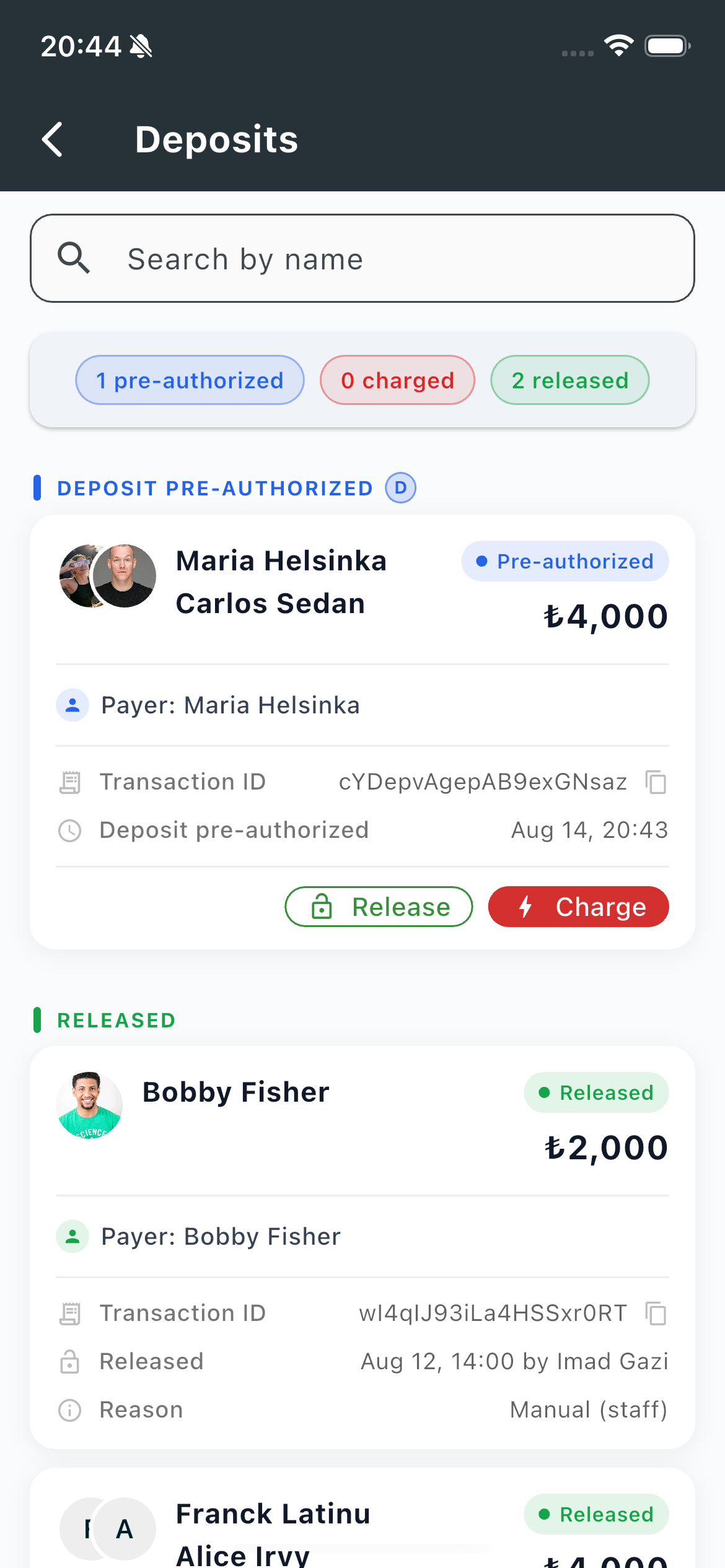
The deposits list shows who is pre-authorized, who was charged, and who was released, with a transaction id and a timestamp. That record is what you want if someone later disputes a no-show charge.
Everything else you need on the day
Registration is useless if the event itself is still a whiteboard. SliceWin also covers:
- Formats: Open Play / Americano, Swiss / Mexicano, Round Robin, Group Round Robin, Knockout (optional group stage), Team Tournament, and Flexible.
- Auto-balancing groups by player level and match history.
- Live leaderboard, stats, and match history.
- Court and match management while the event is running.
Complete list: Tournament formats supported.
Whether you use SliceWin or another tool, the principles above apply. Choose the registration method that fits your community, your commission tolerance, and your workflow.
Frequently asked questions
Direct answers to the questions organizers ask us most about tournament registration and no-shows.
What is the average no-show rate for padel tournaments?
Without payment or deposit protection, organizers commonly report no-show rates in the 15% to 25% range for racket sports tournaments. With in-app payment or a credit card hold, many see that drop into single digits, often around 3% to 7%. These are field estimates, not a published industry study.
How does a credit card hold (pre-authorization) work for tournament registration?
A pre-authorization holds an amount on the player's card without actually charging it. Standard online card holds typically last about 7 days, and some processors support extended holds of up to 30 days. If the player shows up, the hold is released with no charge. If they no-show or cancel late, the organizer captures the hold and the card is charged.
Is a deposit hold legal in the EU under PSD2?
Yes, credit card holds are used legally in the EU, but they must comply with Strong Customer Authentication (SCA) under PSD2. That typically means 3D Secure verification when the hold is created, plus clear disclosure of the amount, duration, and the conditions under which you will capture the funds. This is not legal advice; check current rules with your payment provider.
How much does Stripe charge for tournament registrations?
Stripe's published standard rates (as of 2026) are 1.5% + €0.25 for standard EEA cards, and 2.9% + $0.30 for US domestic cards. International cards cost extra. For a $30 registration, expect roughly $0.70 to $1.20 on a domestic card, more if the card is international. Always confirm on Stripe's pricing page, because rates vary by country and card type.
Can I set different cancellation policies for different tournaments?
Yes. Most modern tournament platforms let you set a free-cancellation window per event. A policy organizers often communicate is 100% refund more than 7 days out, 50% between 48 hours and 7 days, and no refund inside 48 hours. Pair that policy with a waitlist so a cancellation can still fill the slot.
What's the best way to avoid tournament no-shows?
The most effective methods are in-app payment (a card charge or delayed capture tied to registration) and a credit card hold (deposit). Both typically cut no-shows dramatically compared with WhatsApp lists and unpaid signups. Combine either method with a clear cancellation policy and reminders 48 hours and 24 hours before the event.
How do I handle waitlists when someone cancels?
When a cancellation opens a spot, notify waitlisted players immediately. Some tools promote the next person in line with a 12 to 24 hour response window. Others notify eligible players and give the spot to whoever completes registration first. Staff should also be able to add someone from the waitlist by hand.
Should I charge a service fee separately from the registration fee?
Some organizers absorb payment processing fees into the base price; others add them as a separate service fee. Showing the split (for example $30 plus $1.20 processing) can reduce disputes, because the player sees why the total is not a round number. Either approach is fine if you state it at registration.
Can I combine in-app payment and deposit modes in the same tournament?
Most platforms, including SliceWin, use one collection method per tournament. Letting each player pick a different method can raise participation, but it complicates reporting and refunds. Smaller and recurring events usually run cleaner with a single method.
What happens if a player disputes a no-show charge?
Card disputes (chargebacks) do happen. Best practices: disclose the hold amount and capture conditions at registration, keep timestamps showing the player was on the draw, and record the no-show. Most disputes are avoidable when the player clearly agreed to the terms before their card was held.
Choosing the right registration method for your tournament
There is no single correct method. There is a method that matches your roster size, your local payment habits, and how much of your Sunday you still want.
Quick decision framework
| Your situation | Start with |
|---|---|
| Under 15 participants, casual or free | Manual registration |
| 20+ players, occasional event, low card usage | External payment with manual approval |
| 20+ players, recurring, mature card market | In-app payment or deposit mode |
| Maximize margin, minimize commission | Deposit / credit card hold |
Key principles regardless of method
- Communicate the cancellation policy up front, on the registration screen.
- Use a waitlist so cancellations become promotions, not holes.
- Send reminders 48 hours and 24 hours before the tournament.
- Document holds, charges, and no-shows. It helps with disputes and with next month's process.
Whatever tool you use, treating registration management as a first-class problem, not an afterthought, is what separates smooth tournaments from stressful ones.
If you'd like to see how these methods work in practice, SliceWin supports all four registration methods. In-app payment and deposit are available on Pro, with 0% commission from us on your registration revenue.