
1. What is a padel league?
A padel league is a multi-week competition where the same teams play a scheduled set of matches, collect points, and move up or down a standing — not a one-day event with a single winner.
Most club leagues are doubles. Teams stay together for the season, book a court when both pairs are free, play their fixture, and report the score. The table updates by points, then by score difference, then by matches played. That is the whole loop: schedule, play, record, repeat.
A league is different from a social Americano tournament. An Americano is a mixer you can run in an afternoon. A league is the backbone of the month. Players know who they still have to face, the club knows how many matches are still outstanding, and the standing gives everyone a reason to finish their list.
2. Which padel league format should you run?
A padel league format is the rule that decides who plays whom, and how the table is built. For clubs, two round-robin setups cover almost every roster: one open table, or several skill divisions.
Single round robin: every team faces every other team
In a single round robin, the match list is simple: each team plays every other team once. One leaderboard, one set of fixtures, one champion at the end of the cycle.
This is the right padel league format when your group is small and fairly even — think a first season, a closed members’ night, or a company group. Everyone shares the same table, so the story is easy to follow.
- Best roster size: about 6 to 10 teams. Ten teams already means 9 matches per team; For a month-long league it's already too much.
- Standings: points first, then score difference, then matches played.
- Watch-out: a wide skill gap turns the bottom of the table into a list of one-sided scores.
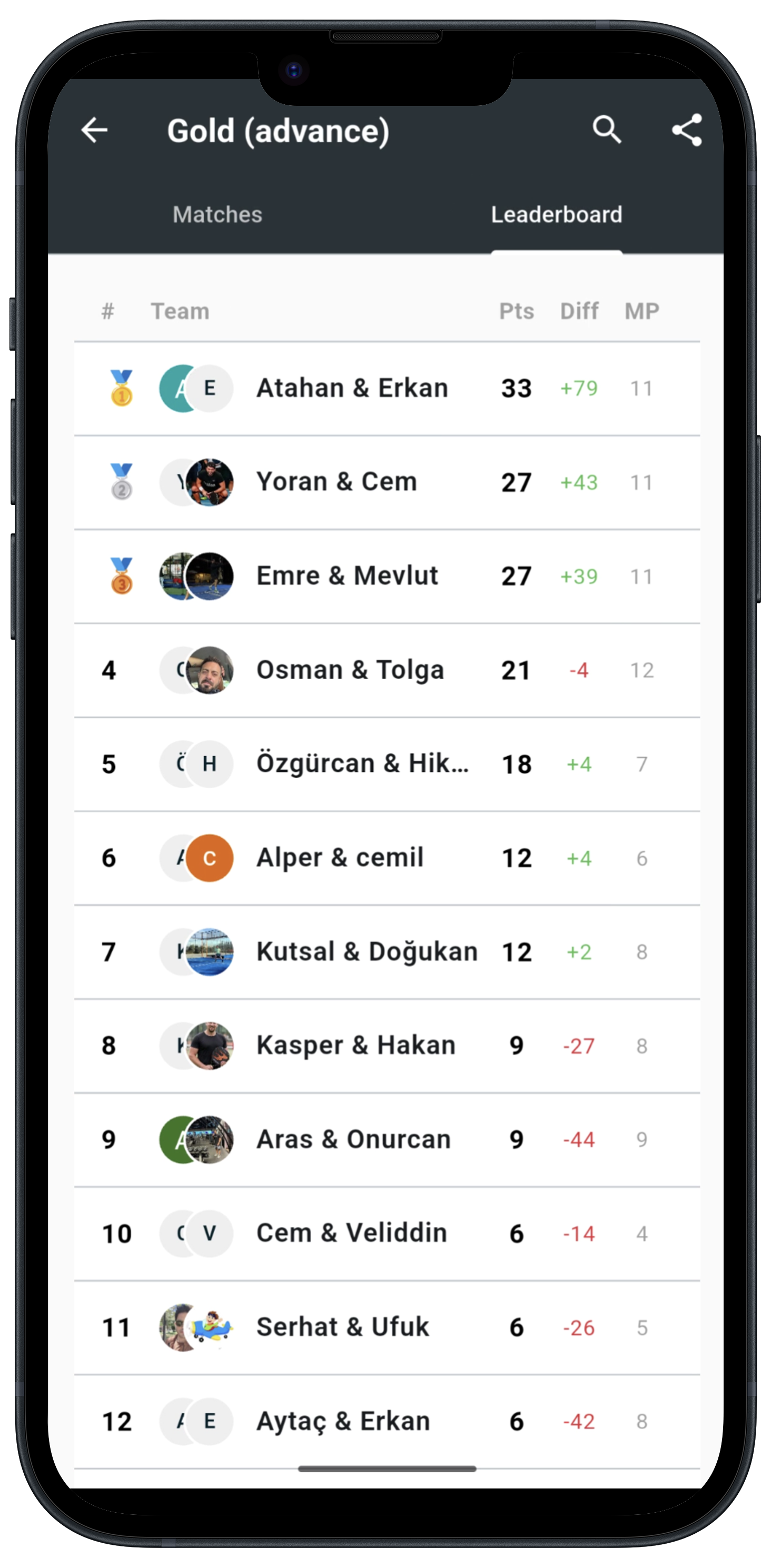
Multi-division round robin by skill (recommended)
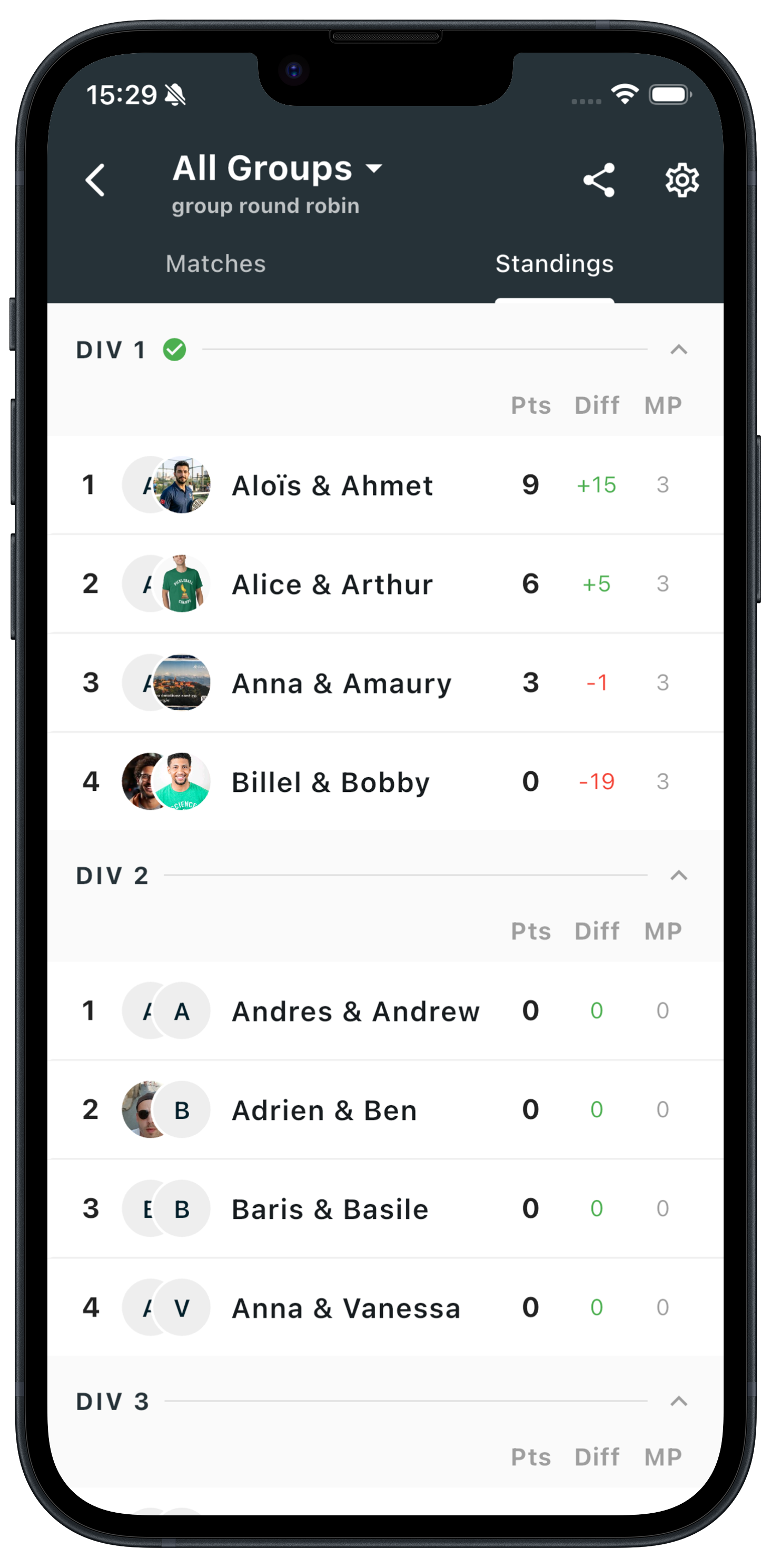
A multi-division padel league splits the club into smaller round robins — Div 1, Div 2, Div 3, or Gold / Silver / Bronze — so teams only face opponents near their own level.
This is the format we recommend once a club has more than one clear skill band. Beginners stop getting blown out. Strong pairs stop walking through weak draws. Every division has its own race, which is what keeps mid-table players checking the app midweek.
Why divisions hold attention
A player in Div 3 is competing for promotion, not for 12th place on a 16-team sheet. Close matches, a short fixture list, and a visible gap to the division above are what make people book the next court.
| Single round robin | Multi-division by skill | |
|---|---|---|
| Who plays whom | Every team faces every other team | Teams only play inside their division |
| Best for | Small, even groups (about 6–10 teams) | Mixed-level clubs that want fairer matches |
| Match load | Grows fast as you add teams | Stays short because each group is small |
| Engagement | One table, one champion | A race in every division, plus promotion stakes |
| Admin | One schedule to publish | Several small groups — easy once software splits them |
3. How does a monthly season with promotion and relegation work?
A seasonal padel league is a repeating cycle — usually a month — where the table is reset and the strongest and weakest teams swap divisions, the same way football moves clubs between tiers.
You do not need a year-long calendar. Run January as its own league. When the last match is in, move the top one or two teams up a division and the bottom one or two down. Open February as a new cycle with those updated groups. Players immediately know what they are playing for: stay up, go up, or avoid the drop.
- Keep the window short. Four weeks is enough time to book courts and short enough that unfinished matches still feel urgent.
- Publish the movement rule before you start. Example: first place is promoted, last place is relegated. No surprises on the last weekend.
- Start the next cycle quickly. The gap between seasons is when people drift back to the same four friends.
Software does not have to “simulate the Premier League” for this to work. It needs a clean standing at month-end and a fast way to open the next league with the new divisions. The promotion story is yours; the table and the match list should not be.
4. When should you add playoffs to a padel league?
Playoffs are a short knockout (or hybrid) finish you add after the regular season when the table alone is not enough of a climax — typically for a club championship or an end-of-season final weekend.
Skip them on a first monthly cycle. Add them when you want a visible final, a trophy, or a reason for the rest of the club to stay and watch. The format that fits a league is a round-robin group stage into a knockout: the season (or a dedicated group stage) guarantees every team several matches, then the top sides move into a bracket. Nobody is eliminated after one bad Tuesday, and you still get a final.
5. How does SliceWin make running a league easy?
Padel league software is the system that builds the match list, updates the table, and lets players (or staff) enter scores — so the organizer is not the spreadsheet. SliceWin is built around that job, including the messy parts: mixed levels, people who will not install an app, and late joiners.
Auto-balanced groups by level and match history
When you choose a multi-division league, SliceWin can split teams into groups using level and previous results instead of a guess on a whiteboard. You can still drag a pair up or down if you know the club better than the numbers. The point is to start with even divisions, not to lock you out of a last-minute tweak.
Match list management
Once the league is live, every fixture sits in one match list, grouped by division. You can see what is pending, what is completed, and how far the cycle has got — for example, 6 of 15 matches played in Div 1 — without opening a second tool.
Staff can enter or correct a score. Players who have the app can report their own result. The standing recalculates from points, difference, and matches played, so you are not re-typing a table after every Sunday.
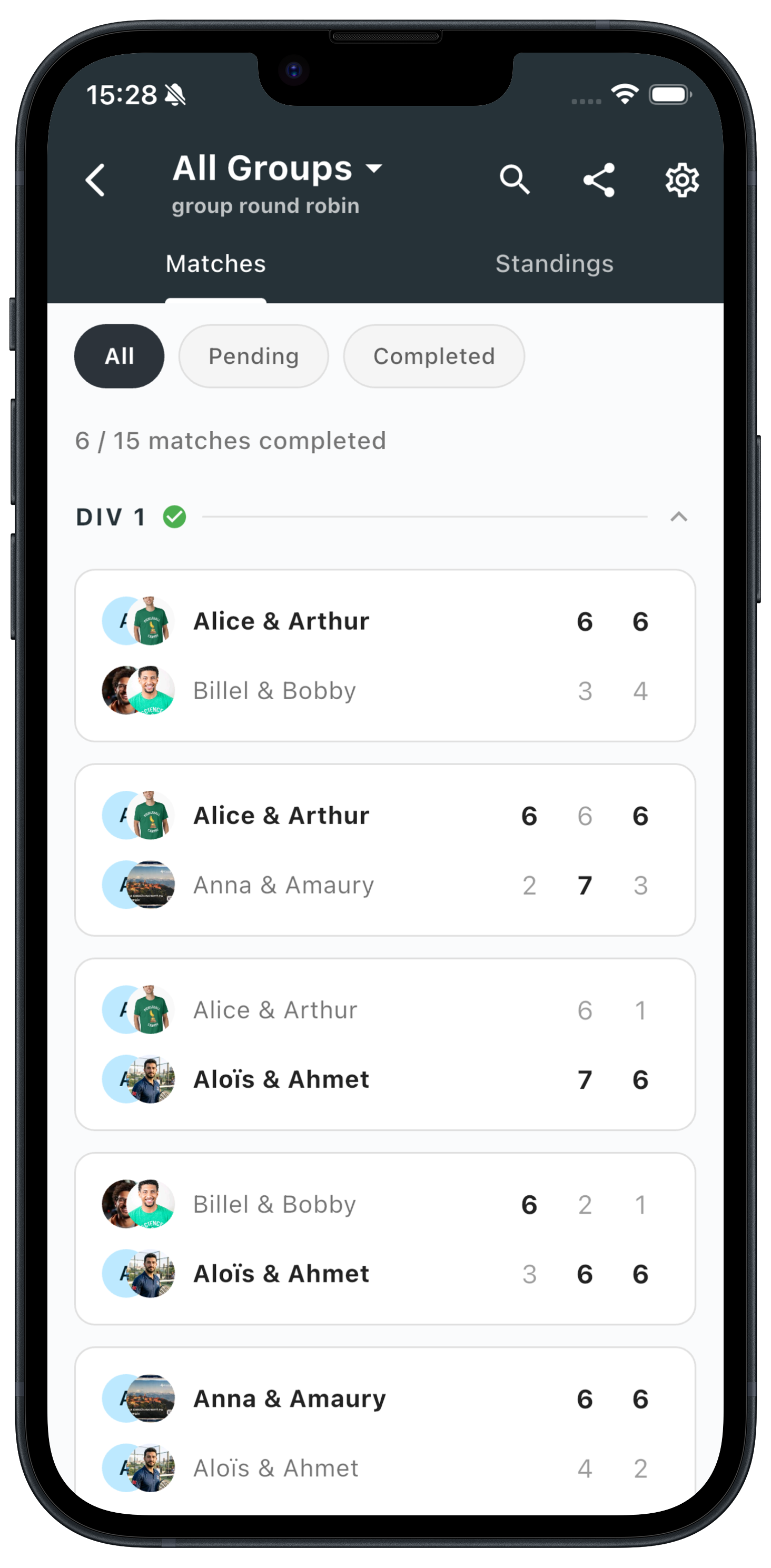
Player management — the app is optional
Not every member will download an app, and a league should not depend on that. In the lobby, staff add teams by hand, see who is in each group, and start the cycle when the roster is ready. Players who never install anything still appear on the match list and the table.
Each player also carries an Elo rating built from all of their matches in previous tournaments and leagues. That long-term number is what makes auto-balancing honest, and it is what keeps people interested after a single season ends: the monthly table resets, the club rating does not.
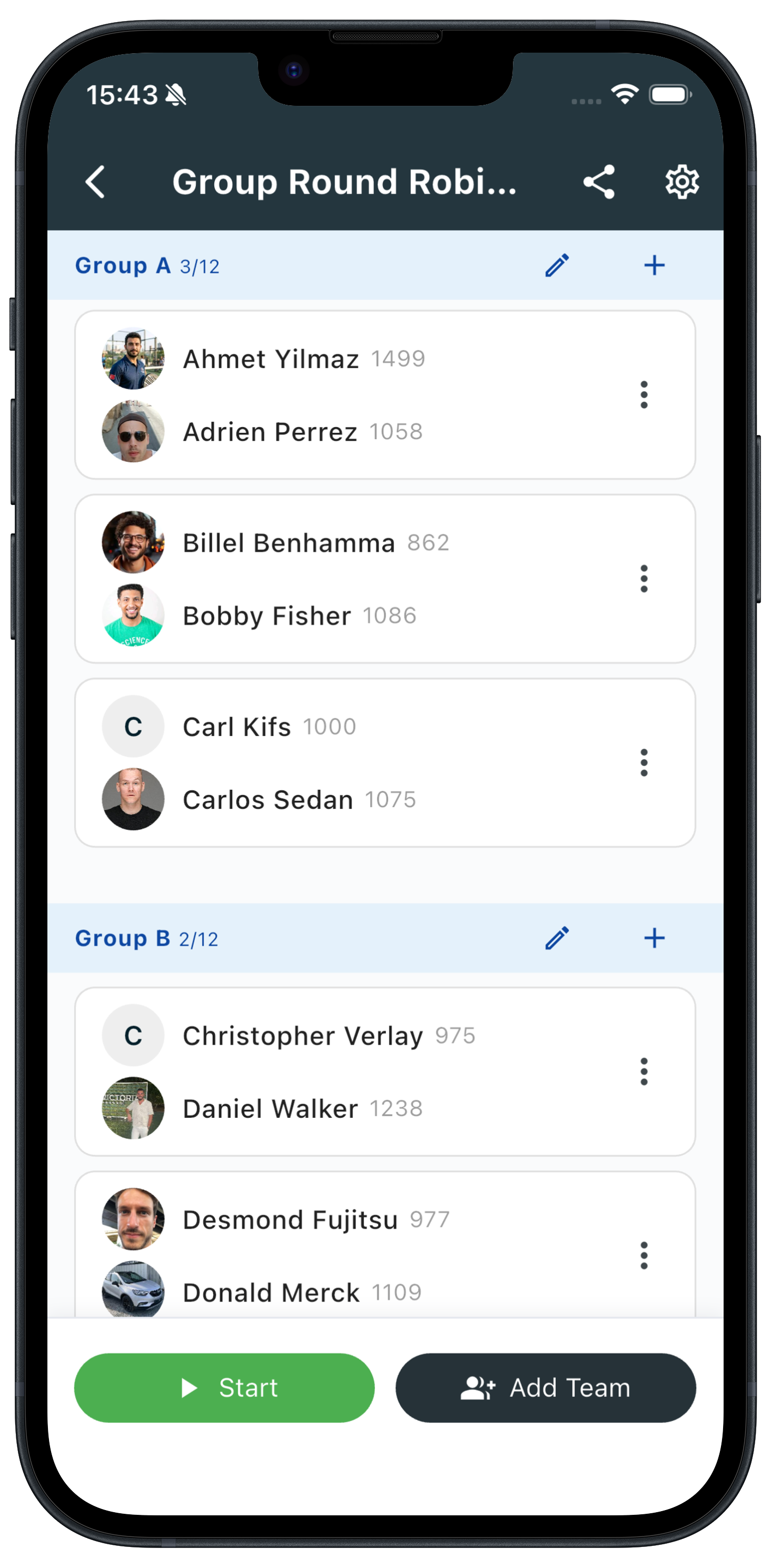
Self-service for players who install the app
Members who do use SliceWin can follow the league without asking the front desk:
- Results: report a score and see it land on the standing after validation.
- History: reopen past matches instead of scrolling a chat thread.
- Photos: attach a match photo so the league feels like a club, not a spreadsheet.
- Leaderboard follow-up: check their division, points, and difference between sessions.
Registration fee collection to cut no-shows
The usual leak in a club league is not the format. It is the pair that withdraws on Thursday after you already blocked a court. Collecting a registration fee up front changes that conversation. With a Pro subscription, SliceWin can take that fee in the app so a late cancellation is no longer a free opt-out.
6. What are the business benefits for padel clubs?
A padel league is a booking plan as much as it is a competition: a known list of matches that must be played inside a fixed window, which is how clubs make court occupation predictable.
If you want the fuller club-operations view — empty weekday slots, the “same group of four” trap, and why flexible match windows fill those hours — read how to fill off-peak hours at your padel club. The league-specific gains are below.
Predictable court occupation
A 24-team, three-division league is a known pile of fixtures. You can see the match count on day one and plan court blocks around it, instead of hoping walk-in bookings appear.
Off-peak hours actually get used
Teams pick a slot that suits both pairs. Many of those slots are weekday mornings and early afternoons — the hours that are hardest to sell as open play.
Players stay because the club has a story
Promotion, relegation, and a club Elo rating give members a reason to renew. The league is the monthly hook; the ranking is what keeps them from drifting to the club down the road.
Less desk time per match
Scores, standings, and “who still has to play” stop living in the organizer’s inbox. Staff step in for disputes and late joiners, not for every 6–4, 6–3.
7. What do players get from a well-run padel league?
For players, a good padel league is a fair calendar of matches against people they would not have texted themselves — plus a standing that makes improvement visible.
- New connections. Fixed teams still meet new opponents every fixture. That is how a club stops being four WhatsApp groups that never mix.
- Balanced games. Divisions (and Elo-aware grouping) keep most nights competitive instead of 6–1, 6–0.
- A reason to improve. Points, difference, and a long-term rating give practice a target: hold Div 2, push for Div 1, or simply beat last month’s difference.
- A community, not a one-off. The season ends; the next cycle and the club ranking are still there. That continuity is what players talk about at the bar.
8. Frequently asked questions
These are the questions club managers usually ask before they launch a first season.
How many teams should a padel league have?
A single round robin works best with about 6 to 10 teams so everyone faces everyone without an unmanageable match list. A multi-division league should keep each division around 4 to 8 teams. If you have more players than that, add another division instead of stuffing one table.
What's the difference between a league and a tournament?
A padel league runs over weeks or months. Teams play a scheduled set of matches, often booking courts when it suits them, and a standing updates after every result. A tournament is usually a shorter event — a social Americano, a Mexicano, or a knockout weekend — where most matches happen on a fixed day.
How long should a padel league season be?
A monthly cycle is the most practical default for clubs. Four weeks is long enough for teams to book and play their matches, and short enough that the table still feels urgent. Stretch to six or eight weeks only if each team has a long list of fixtures.
How do you organize skill divisions in a padel league?
Group teams so players in the same division are close in level. Use past results, a club ranking, or an Elo rating built from previous tournaments and leagues. Aim for 4 to 8 teams per division, then let the software auto-balance groups by level and match history before you start. Adjust by hand if you know a pair is sandbagging or returning from injury.
Can players join mid-season?
Yes. Club staff can add a team while the league is live. Late joiners play the remaining matches in their division. Standings are based on points and matches played, so a new team is not frozen out of the table — they simply have fewer results until they catch up.
What software should I use to run a padel league?
Use padel league software that generates the match list, updates standings automatically, lets players report scores, and still works if some members never download an app. SliceWin covers those basics.